September 6, 2026
Gumpoldskirchen Guide to Wines & Heurigers
Architecture, Culture, Earth Science, Guide, History, Travel
Top attractions:
A Little Gem between Baden and Mödling
If there is one thing certain about Gumpoldskirchen is that this medieval gem is not shy of itself. The town proudly declares itself to be the most famous wine town in Austria. Sounds outrageous, though, not without some solid background behind the statement. Situated between two popular tourist towns Mödling and Baden bei Wien, Gumpoldskirchen attracts a large number of local visitors with good taste as well. Though the town gets attention throughout the year, it is especially appreciated during the Wine Autumn, peaking with the Genussmeile Thermenregion festival.
Gumpoldskirchen is located on the so-called thermal line (ger. Thermenregion), which produces unique climatic conditions for viticulture. As a matter of fact – like no other part of the world. To unravel the distinctiveness of Gumpoldskirchen, we must take a deeper understanding of its geographical location and the history of the long-standing traditions of wine cultivation in the region.

John of Nepomuk is the saint of Bohemia, where according to the legend he was drowned in VItava River by the orders of Wenceslaus IV. His statues could be found across Central Europe near bridges as a protector from floods and drowning. Photo by Alis Monte [CC BY-SA 4.0], via Connecting the Dots

Despite all historical gems, wine is what Gumpoldskirchen is know the most. Photo by Alis Monte [CC BY-SA 4.0], via Connecting the Dots
Gumpoldskirchen Details
- Location: Mödling District
- State: Lower Austria
- Coordinates: 48.0455° N, 16.2765° E
- Distance from Vienna: 26km / 16mi
- First mentioned: 1,140 CE
- First settlers: 6,500 BC
- Population: 3,914 (2019)
- Area: 8.11 km² (3.13 sq mi)
- Elevation: 250m / 820ft
- Forecast: Gumpoldskirchen weather
- Tours: Full-day Vienna wood wine tour
- Best time to visit: May-July and early autumn, when heurigers are open
Map of Gumpoldskirchen

Every September Thermenregion organise Weinherbst to celebrate the fine wines of the region. Photo by Alis Monte [CC BY-SA 4.0], via Connecting the Dots
History and Origins of Gumpoldskirchen
With all respect to the narrow, beautiful valleys of Gumpoldskirchen, the town could be easily mistaken for a one-street village. All the important buildings could be found along it.
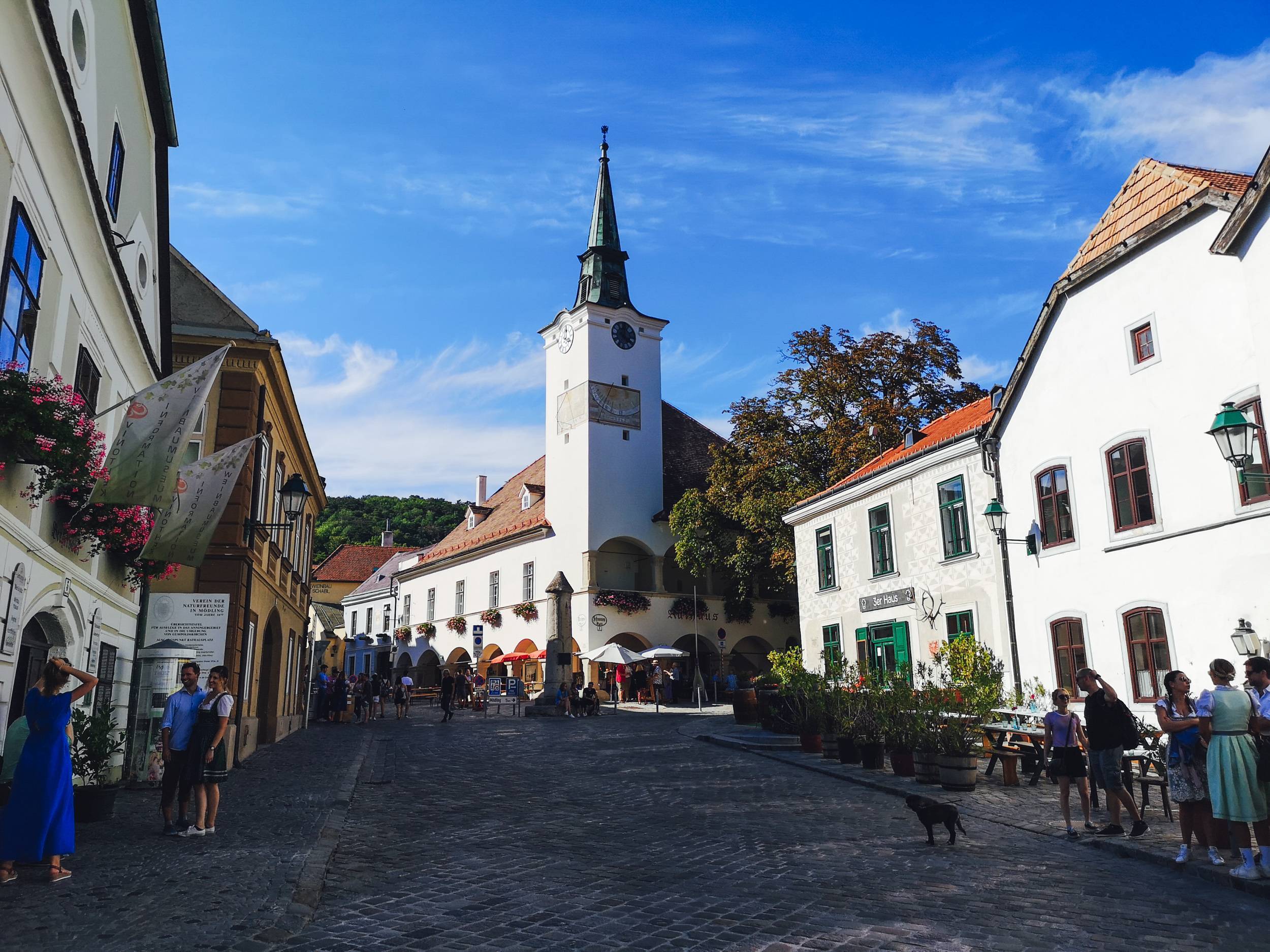
Rathaus (town hall) is the second most prominent building in Gumpoldskirchen. Photo by Alis Monte [CC BY-SA 4.0], via Connecting the Dots
The Wiener Strasse (Vienna st.) leads slowly uphill, where at Shrannenplatz by the town hall, the street continues as Kirchengasse (Church st.). The latter one finishes the job at the very heart of the town – Kirchenplatz. This square is surrounded by most of the main attractions of Gumpoldskirchen, including the Castle of Teutonic Order, Parish Church of St. Michael, the Bergerhaus with Wine Tree Museum, and the old home of the local judges.
I imagine that the layout of the town probably never changed that much, and the top of the hill always was the most important part of the settlement. This is the place where the castle stands after all, but it hasn’t been like that all the time. Though the name of the town is linked with Gumpold of Passau (10th century), the settlement outgrew its current name and even the Castle, which was built by the Teutonic Order somewhere in the 11th or 12th century.

The Castle now serves as a convent for Teutonic Order and as a hotel for seminars. Photo by Alis Monte [CC BY-SA 4.0], via Connecting the Dots
Prior to the order, the Romans inhabited the place, before them – the Celtic people and even they are outdated by even more ancient culture, dating as far back as 6.500 BC. All of them had one thing in common – they all cultivated wine on the slopes of Eichkogel and the neighboring area.
Castle of Gumpoldskirchen
The castle, often called the Deutsches Haus and today known as Schloss Gumpoldskirchen, is closely tied to the Teutonic Order. In 1241 Duke Frederick II granted the Order the parish of Gumpoldskirchen together with vineyards, which laid the foundation for the later Schlossweingut (castle wine estate). Through the late Middle Ages the complex had defensive features such as a moat, a drawbridge and shooting slits, and passages that connected the castle with the nearby Parish Church of St. Michael. Wine pressing took place on-site; the former press house corresponds to today’s “Gartensaal”, while the wine cellars still lie beneath the current seminar rooms.
The baroque rebuilding began in 1689; later, in 1869 the roofs were re‑tiled and the church tower changed from an onion dome to a pointed spire. In the 20th century, parts of the castle served as a convent and retirement home for sisters of the Teutonic Order; during the Nazi period it was earmarked for administrative use, and after 1947 it returned to the Order. A major renovation in 1999–2000 stabilized and adapted the complex; today it functions as a convent and a seminar hotel, keeping the wine and monastic heritage alive in the town center.
Gumpoldskirchen Geography
The town is located to the east of Vienna Woods and to the south of Eichkogel. The location describes the beautiful landscape surrounding Gumpoldskirchen but it doesn’t explain why the town was built here in the first place. The dominant features of the local topography are directly linked to that reason.
Gumpoldskirchen is located on the Thermal Line, which is the rupture zone between the Vienna basin and Eastern Alps. To put it simply – this is where the Alps begin. Thanks to the shift of landscape, two different climate zones intersect directly, where Gumpoldskirchen and Eichkogel are located.

It might not look like it, but there is a lot of happening beneath this peaceful landscape of Thermenregion. Photo by Alis Monte [CC BY-SA 4.0], via Connecting the Dots

EIchkogel is only 367m / 1204ft above sea level but throughout the history, it had big implications. Photo by Alis Monte [CC BY-SA 4.0], via Connecting the Dots
This geographical location has another very important feature affecting the taste of wine and that is due to the exceptional mineral richness of the soil. This is the Thermal line after all, with numerous natural hot mineral-rich hot baths throughout it.
All of this creates a basis for unique conditions to cultivate wine. Wines of fruit, acidity, and maturity grow in these lands like nowhere else. The people who inhabited the area before understood this, and to some extent, much more than most of us.
With rich viticulture, it is no surprise that Gumpoldskirchen established itself as a market town. Wandering around the narrow medieval streets of Gumpoldskirchen, one could almost hear merchants’ shouting echoes from the past. The whole rich scenery of the area could be best observed from the Calvary to the northwest of the town.

The Calvary of Gumpoldskirchen was built by its citizens in the 19th century after the town was spared by the cholera epidemic in 1856. Photo by Alis Monte [CC BY-SA 4.0], via Connecting the Dots
Fine Wines of Gumpoldskirchen
There are two things everybody must know before coming to Gumpoldskirchen: Zierfandler, and Rotgipfler. Both are white wines and are almost endemic to Gumpoldskirchen. Don’t even bother with other wines until you taste these two – it is a total must for any vinophile.
Zierfandler
This one is also referred to as “the late red”, though it doesn’t have much in common with red wines. It is because the grapes turn red on the sunny side at the very end of the season when they are fully ripe. Supposedly, Zierfandler reaches its highest quality as an old wine but I assure you that the rich taste of this fine white wine, with a pleasant acidity and a delicate bouquet, will leave nobody disappointed.
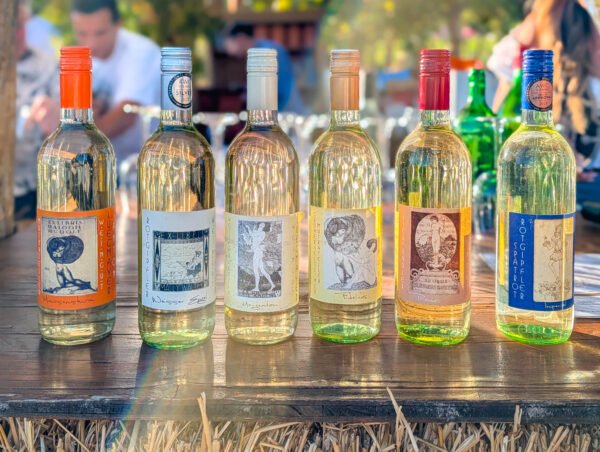
Wine palette at Anton Luegmayer. Photo by Alis Monte [CC BY-SA 4.0], via Connecting Vienna
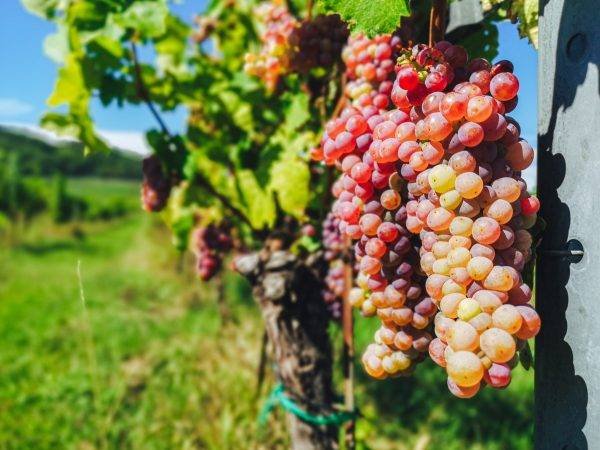
Zierfandler wine grapes turn red at the very end of the season. Photo by Alis Monte [CC BY-SA 4.0], via Connecting the Dots
Rotgipfler
It is easy to mistake this wine for a red one because even its name suggests it, but just as Zierfandler – Rotgipfler is a white wine. It has a similar rich taste to Zierfandler, mixed between acidity, fruitiness, and even honey, but Rotgipfler goes easier down your throat than its counterpart.
Spätrot-Rotgipfler
Another unique taste of Gumpoldskirchen is Spätrot-Rotgipfler, which is a Cuvee made out of Zierfandler and Rotgipfler. Even though the origins of Zierfandler and Rotgipfler are not proven, Spätrot-Rotgipfler is in fact a unique product of Gumpoldskirchen.
Königswein
Also, look out for wines named as “Königswein”, which is an Oscar-winning wine, given out in the late season for meeting the highest quality standards. For example, in 2019 the winner was a Spätrot-Rotgipfler variety wine made by Weinbau Proisl. For now, this fine wine could be tasted at Kirchenplatz.
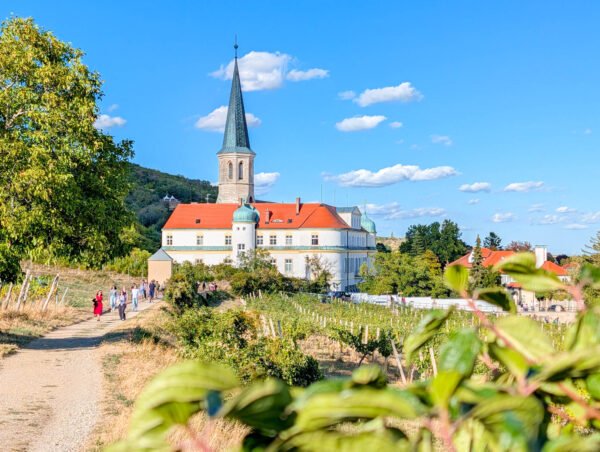
Schloss Gumpoldskirchen on Genussmeile weekend. Photo by Alis Monte [CC BY-SA 4.0], via Connecting Vienna
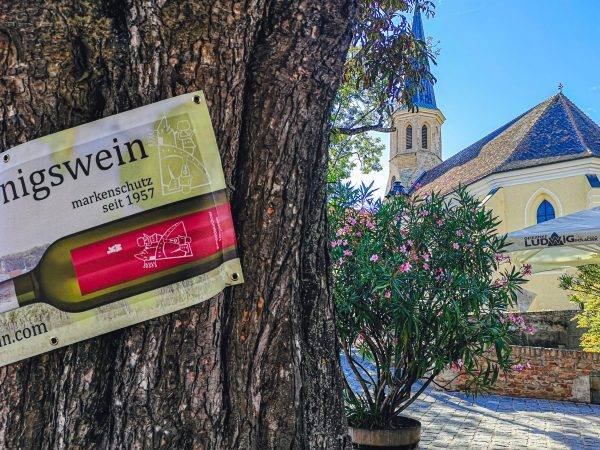
Whoever wins the title of Königswein – gets to sell their wine in Kirchenplatz for the next year. Photo by Alis Monte [CC BY-SA 4.0], via Connecting the Dots
Wine Festivals
Austrians know how to produce and appreciate their wine. It is even more so in the areas famous for viticulture, like the Thermenregion. From generation to generation, winemakers have passed down the knowledge of the production of fine wines, endemic to this exceptional region. Throughout the year the citizens of Thermenregion organize various festivities, celebrating the cycle of their wine production.
The biggest concentration of those events is during the fifth Austrian season – the Lower Austrian Wine Autumn, from August to November, but it doesn’t apply only to that period. You can check the current cuisine and wine in events in Lower Austria here.

Weinherbst (August-October) is the high season for Gumpoldskirchen. Photo by Alis Monte [CC BY-SA 4.0], via Connecting the Dots

Kirchenplatz during Weinherbst in early September. Photo by Alis Monte [CC BY-SA 4.0], via Connecting the Dots
Weinherbst Gumpoldskirchen 2026
The Weinherbst Gumpoldskirchen 2026 runs from 4 September to 18 October 2026. The calendar includes:
- Opening: Friday 4 September at 15:00, Goldknöpferl
- Genussmeile Thermenregion: weekends 5–6 and 12–13 September
- Dämmerschoppen: Saturday 5 September at 15:00, Schloss Heuriger
- Frühschoppen: Sunday 6 September at 11:00, Kraghütte
- Live music: Saturday 12 September at 16:00, Rolph at Kraghütte
- Stürmisch wird’s: Saturday–Sunday 12–13 September from 14:00, Weingut Schabl
- Sax at Goldknöpferl: Saturday 19 September at 15:00
- Closing: Sunday 20 September at 12:00, Goldknöpferl
- Gasthof Keller culinary evening: Friday 25 September at 18:00
- Oktoberfest: Friday 2 October at 11:00, Hochkräutl
- Tag der offenen Kellertür: Saturday–Sunday 17–18 October from 14:00–19:00
Live Heuriger openings are listed at gumpoldskirchen.at.
Wine Tours
I rank Gumpoldskirchen and Thermenregion as one of the top destinations for wine hiking trips from Vienna. If you want to learn more about the fine wines produced along the thermal line and the history of viticulture in the region, I suggest getting a tour with a professional guide. The best one, which offers a tour including a visit to Gumpoldskirchen, is listed below.
- From Vienna: Full-Day Vienna Woods Wine Tour (7.5 – 8.5h | € 159/person) The price includes 2 separate wine tastings, vineyard and winery visits, round-trip to Vienna Woods, and a professional hiking and wine guide in either English or German. Groups of up to 6 people.

Been there, done that. Many times. Photo by A.L. [CC BY-SA 4.0], via Connecting the Dots

Genussmeile is the climax of wine drinking in Thermenregion. Photo by Alis Monte [CC BY-SA 4.0], via Connecting the Dots
Heurigers in Gumpoldskirchen
A true heuriger might work only a couple of weeks during the production season, but they can be open as much as they want during the off-season, selling the previous year’s wine. If you want to experience an authentic Heuriger experience, do it during the autumn or at least try wines that are younger than a year old.
Luckily, if you are limited on time, some places offering local wine are open much more often.
Gumpoldskirchen Heuriger Calendar 2026
Ausgesteckt dates below follow the official municipal Heurigenkalender for 2026 (plus Schlossheuriger dates for Hühnel & Hammer). For last-minute changes, check gumpoldskirchen.at/Heurigenkalender.
- Adventuregolf Gumpoldskirchen, “The Clubhouse” (Pfaffstättnerstraße 1930) — Open: Sun 6.9; then Tue–Sun blocks 8.9–13.9, 15.9–20.9, 22.9–27.9, 29.9–4.10, 6.10–11.10, 13.10–18.10, 20.10–25.10, 27.10–1.11, 3.11–8.11, 10.11–15.11, 17.11–22.11, 24.11–29.11, 1.12–6.12, 8.12–13.12, 15.12–20.12, 22.12–27.12, 29.12–31.12.2026 (Hours: Tue–Sun 10:00–21:00; Mon closed)
- Altes Zechhaus, Fam. Krug (Kirchenplatz 1) — Open: Tue–Sat blocks 8.9–12.9, 15.9–19.9, 22.9–26.9, 29.9–3.10, 6.10–10.10, 13.10–17.10, 20.10–24.10, 27.10–31.10, 3.11–7.11, 10.11–14.11, 17.11–21.11, 24.11–28.11, 1.12–5.12, 8.12–12.12, 15.12–19.12, 22.12–26.12, 29.12–31.12.2026 (Hours: Tue–Fri 17:00–23:00; Sat 11:00–23:00; Sun & Mon closed)
- Bier Pub (Wienerstraße 8) — Open: 6.9–31.12.2026 (Hours: Mon–Fri 10:00–16:00; Sat 9:00–16:00 & 22:00–01:00; Sun 9:00–14:00)
- Fassbinderhof – Birgit & Christoph Grill (Wienerstraße 22) — Open: Sun 6.9; then Tue–Sun blocks 8.9–13.9, 15.9–20.9, 22.9–27.9, 29.9–4.10, 6.10–11.10, 13.10–18.10, 20.10–25.10, 27.10–1.11, 3.11–8.11, 10.11–15.11, 17.11–22.11, 24.11–29.11, 1.12–6.12, 8.12–13.12.2026 (Hours: Tue–Sat 11:00–23:00; Sun 11:00–17:00; Mon closed)
- Forthuber – Atus Stüberl (Wienerstraße 154c) — Open: Mon–Sat blocks 7.9–12.9, 14.9–19.9, 21.9–26.9, 28.9–3.10, 5.10–10.10, 12.10–17.10, 19.10–24.10, 26.10–31.10, 2.11–7.11, 9.11–14.11, 16.11–21.11, 23.11–28.11, 30.11–5.12, 7.12–12.12, 14.12–19.12, 21.12–26.12, 28.12–31.12.2026 (Hours: Mon–Fri 10:00–22:00; Sat & holidays 10:00–18:00; Sun closed)
- Heurigen Restaurant “Zum alten Presshaus” – Fam. Reisenhofer (Wienerstraße 20) — Open: 6.9–9.9, 12.9–16.9, 19.9–23.9, 26.9–30.9, 3.10–7.10, 10.10–14.10, 17.10–21.10, 24.10–28.10, 31.10–4.11, 7.11–11.11, 14.11–18.11, 21.11–25.11, 28.11–2.12, 5.12–9.12, 12.12–16.12, 19.12–23.12, 26.12–30.12.2026 (Hours: Mon–Wed & Sat 10:00–22:00; Sun 10:00–20:00; Thu & Fri closed)
- Heuriger Spaetrot (Wienerstraße 1) — Open: Thu–Mon from Sun 6.9 through 31.12.2026 (Hours: Thu–Mon 12:00–23:00; Tue & Wed closed)
- Weingut Hühnel & Hammer, Schlossheuriger (Kirchenplatz 4) — Open: 5–6.9, 12–13.9, 19–20.9.2026 (Hours: from 12:00; Schlossgarten — outdoor)
- K’Eck „Kati’s ECK Cafe“ (Wienerstraße 33) — Open: 10.9–13.9, 17.9–19.9, 24.9–27.9, 1.10–3.10, 8.10–11.10, 15.10–17.10, 22.10–25.10, 29.10–31.10, 5.11–8.11, 12.11–14.11, 19.11–22.11, 26.11–28.11, 3.12–6.12, 10.12–12.12, 17.12–20.12, 24.12–26.12, Thu 31.12.2026 (Hours: Thu–Fri 8:00–12:00 & 15:00–18:00; Sat & Sun 8:30–16:00; Mon–Wed & holidays closed)
- Weinbau Bauer (Wienerstraße 58) — Open: 17.10–23.10.2026 (Hours: Mon–Sat from 15:00; Sun & holidays from 11:00)
- Weinbau Proisl (Wienerstraße 6) — Open: 10.10–16.10, 21.11–29.11.2026 (Hours: Mon–Fri from 16:00; Sat from 15:00; Sun & holidays from 11:00)
- Weinbau Rechtberger (K. Schellmanngasse 27) — Open: 29.10–7.11, 26.11–5.12.2026 (Hours: daily from 11:00)
- Weinbau Rieger (Neustiftgasse 36) — Open: 9.9–13.9, 16.9–20.9, 14.10–18.10, 18.11–22.11, 27.12–30.12.2026 (Hours: Mon–Fri from 14:00; Sat, Sun & holidays from 12:00)
- Weinbau Straitz & Straitz (Badenerstraße 26) — Open: 6.9–21.9, 1.10–20.10, 1.11–20.11, 1.12–20.12.2026 (Hours: daily from 12:00)
- Weinbau Stöger “13er Haus” (Jubiläumsstraße 13) — Open: Sun 6.9; 10.9–13.9; 15.10–15.11; 26.12.2026–12.1.2027 (Hours: Mon–Fri from 17:00; Sat from 16:00; Sun & holidays from 12:00)
- Weingut Christian Schabl (Kirchengasse 6) — Open: 1.10–11.10, 12.11–22.11.2026 (Hours: Mon–Fri from 15:00; Sat, Sun & holidays from 12:00)
- Weingut Erich Heimburg (Rotes Mäuerl 270) — Open: 24.10–1.11.2026 (Hours: Mon–Fri from 15:00; Sat, Sun & holidays from 12:00)
- Weingut Hannes Hofer (Neustiftgasse 4) — Open: 26.9–4.10, 31.10–8.11, 12.12–20.12.2026 (Hours: Mon–Sat 15:00–23:00; Sun & holidays 11:00–23:00)
- Weingut Kaufmann-Schellmann (Mödlingerstraße 22) — Open: Sun 6.9; 12.9–13.9, 19.9–20.9, 26.9–27.9, 3.10–4.10, 10.10–11.10, 17.10–18.10, 6.11–8.11, 13.11–15.11, 20.11–22.11.2026 (Hours: Mon–Fri from 15:00; Sat, Sun & holidays from 11:30)
- Weingut zum Pranger (Kirchengasse 1) — Open: 25.9–4.10, 16.10–25.10, 4.12–6.12.2026 (Hours: daily 15:00–23:00)
- Zum Gumpold (Wienerstraße 81) — Open: Sun 6.9; then Tue–Sun blocks 8.9–13.9, 15.9–20.9, 22.9–27.9, 29.9–4.10, 6.10–11.10, 13.10–18.10, 20.10–25.10, 27.10–1.11, 3.11–8.11, 10.11–15.11, 17.11–22.11, 24.11–29.11, 1.12–6.12, 8.12–13.12, 15.12–20.12, 22.12–27.12, 29.12–31.12.2026 (Hours: Tue–Sat 10:30–20:30; Sun 10:30–18:00; Mon closed)

Freigut Thallern is a winery of Heiligenkreuz Abbey next to Gumpoldskirchen. Photo by Alis Monte [CC BY-SA 4.0], via Connecting the Dots

Out of all Gumpoldskirchen heurigers, Krug is probably the most famous and the most awarded one. Photo by Alis Monte [CC BY-SA 4.0], via Connecting the Dots
Best Hotels in Gumpoldskirchen
- Freigut Thallern – Established within a 12th-century winery of Heiligenkreuz Abbey just next to Gumpoldskirchen. Perfect for vinophiles.
- Hotel Landhaus Moserhof – 4-star hotel in central Wiener Strasse with SPA and swimming pool. Perfect for swimmers and during the hot season.
- Hotel Turmhof – 4-star hotel close to Kirchenplatz with views to vineyards. The best hotel overall.
- Schloss Gumpoldskirchen – 3-star hotel in the Castle of Teutonic Order itself. Might be a less-comfy option but perfect for those who want to take a closer look at this historic building.
- Pension Haus Böhm – 3-star hotel located a bit further from the city center, but then again, Gumpoldskirchen is a small town. It is also the cheapest option on the list. Perfect if you plan to spend most of the time outside.

All content and photos by Alis Monte, unless stated differently. If you want to collaborate, contact me on hi@connectingvienna.com Photo by Alis Monte [CC BY-SA 4.0], via Connecting the Dots
Wine Tours to Other Regions
Frequently Asked Questions
Where is Gumpoldskirchen located?
About 30km from Vienna, on the thermal line between Baden bei Wien and Mödling
What is Gumpoldskirchen famous for?
The Castle of Teutonic Order and its wines. Most notably Zierfandler, and Rotgipfler. Both are white wines and are, almost, endemic to Gumpoldskirchen.
When is the best time to visit Gumpoldskirchen?
May-July and Early Autumn, when heurigers are open.
Is Zierfandler wine good?
This one is also referred to as “the late red”, though has not much in common with the red wines. It is because the grapes turn red on the sunny side at the very end of the season, when they are fully ripe. Supposedly, Zierfandler reaches its highest quality as an old wine but I assure that the rich taste of this fine white wine, with a pleasant acidity and a delicate bouquet, will leave nobody disappointed.
Is Rotgipfler wine good?
It is easy to mistake this wine with a red one because even its name suggests it, but just as Zierfandler – Rotgipfler is a white wine. It has a similar rich taste to Zierfandler, mixed between acidity, fruitness and even honey, but Rotgipfler goes easier down your throat than its counterpart.
What is der “Königswein”?
Der “Königswein” is an Oscar-winning wine in Gumpoldskirchen, given out in the late season for meeting the highest quality standards.
What is Spätrot-Rotgipfler?
One of the unique tastes of Gumpoldskirchen is Spätrot-Rotgipfler, which is a Cuvee made out of Zierfandler and Rotgipfler - two famous local white wine grapes.
