September 27, 2026
Semmering Railway History: Ghega to Sommerfrische
History, Payerbach-Reichenau, Rax, Semmeringbahn, Train
Top attractions:
Semmeringbahn: First Mountain Railway
Austria’s railway age arrived with the urgency of a country that had decided mountains should no longer be an excuse. After early experiments — the Linz–Budweis horse railway from 1832, the Kaiser-Ferdinands-Nordbahn from 1836 — the southern line pushed toward Gloggnitz. The ceremonial opening of the Wien–Gloggnitz stretch on 5 May 1842 put steam at the foot of the Semmering and left one awkward question hanging in the alpine air: how do you actually cross the pass?
Many contemporaries called it impossible. Venetian engineer Carl Ritter von Ghega disagreed with the calm of someone who had already done the maths. His 1847 design aimed for a maximum gradient of about 25‰. Construction on the mountain section began amid the turmoil of 1848 — partly as work for thousands when the empire needed both a railway and employment. The finished mountain railway runs roughly 41.8 km with about 459 m of elevation difference: not a toy tourist line, but a serious piece of nineteenth-century nerve.
Locomotives were another gamble. An 1851 competition on the Payerbach–Eichberg stretch tested four engines — Bavaria, Seraing, Wiener Neustadt, and Vindobona. None was perfect on its own; Wilhelm von Engerth combined their strengths into the Engerth system that finally made the climb workable. Passenger traffic over the Semmering opened on 17 July 1854. A later Ghega monument inscription put the dream in one line: the railway makes distances disappear, fosters material interests, and spreads culture. Standing under the Rax today, you can still feel all three claims arguing their case.
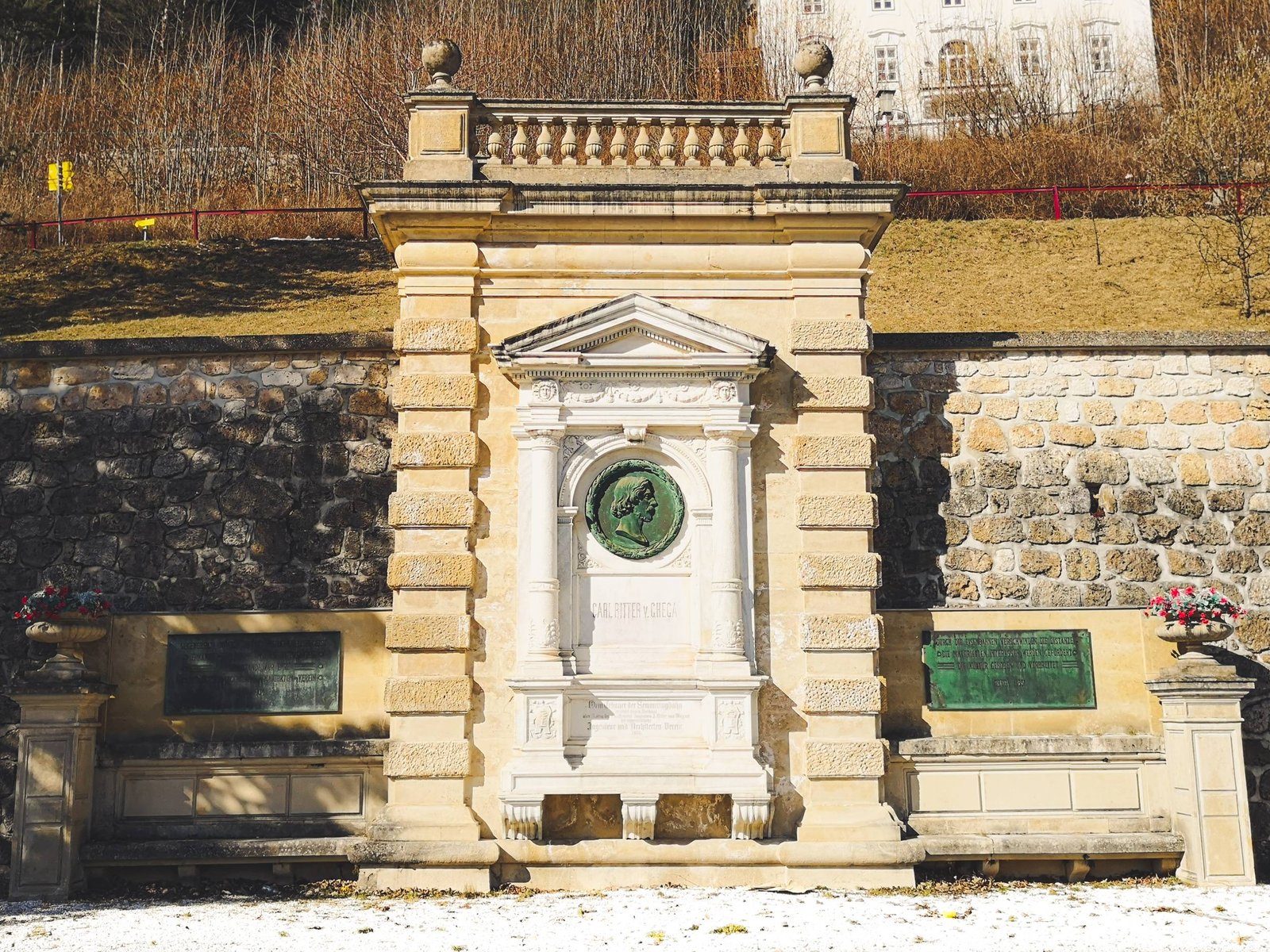
Carl von Ghega and the mountain railway. Photo by Alis Monte [CC BY-SA 4.0], via Connecting Vienna
Also known as: Semmering Railway, Semmeringbahn, Payerbach-Reichenau, Reichenau an der Rax, Rax valley, Sommerfrische unter der Rax, Historischer Bahnhof Payerbach-Reichenau.
Semmeringbahn Bridges & Tunnels
Stone did half the work; people did the rest. Viaducts in a classicist, almost Roman spirit carried the line across gorges — among them Payerbach’s Schwarza Viaduct (1851) and the two-tier Kalte Rinne (1853, roughly 46 m high), still one of the Semmeringbahn’s postcard silhouettes. Tunnels were blasted with black powder, often via shafts so crews could attack from several faces at once. Ghega capped tunnel lengths near 1,500 m; the main Semmering tunnel is about 1,430 m.
Keeping that mountain line safe meant households as much as masonry. About 55 signalmen’s houses served as workplace and home; more signal cabins covered blind spots and busy crossings. Married men worked round-the-clock shifts, talking to drivers with baskets, flags, bells, whistles, and lanterns — and covering windows at night so indoor lamps would not be mistaken for signals. If you hike near the line today, those small houses are part of the landscape’s grammar: quiet proof that alpine railways are social systems, not just engineering diagrams.
Semmering Tourist Town History
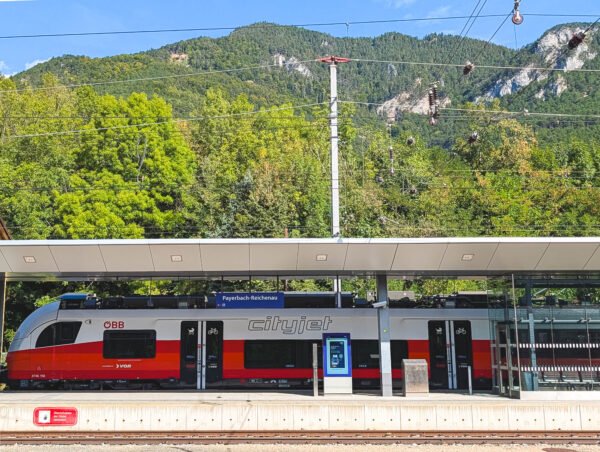
A modern Cityjet at Payerbach-Reichenau. Photo by Alis Monte [CC BY-SA 4.0], via Connecting Vienna
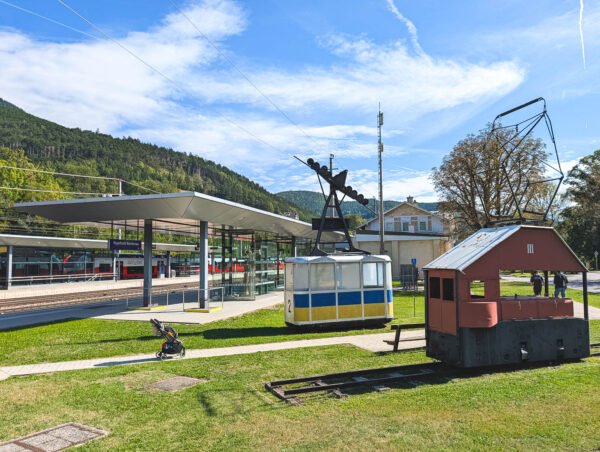
Historic railway display at the station. Photo by Alis Monte [CC BY-SA 4.0], via Connecting Vienna
In 1854 the stop at Payerbach was modest: a provisional waiting room and a small restaurant. Tourism changed the brief almost overnight. In 1868 the Südbahn company built a proper stone station — architects Wilhelm Flattich and Franz Wilhelm — with a glass-and-iron canopy and a matching station restaurant opposite. Extensions followed in 1888 and 1902. In January 1895, at Reichenau’s request, the name became Payerbach-Reichenau: one station, two villages, one shared destiny as Vienna’s alpine foyer.
A Südbahn brochure of the era was not shy. It called Payerbach the greatest tourist town in Austria — or perhaps in the whole Alpine world — describing weekend “waves of peoples” pouring from the trains and ebbing back to Vienna on Monday morning. Fiakers waited on the forecourt. Three platforms handled the crush. Around 1900, the boards claim, this was among the busiest stations in the monarchy. If that sounds like marketing hyperbole, stand on the platform on a sunny Saturday even now and recalibrate: the crowds are different, but the logic is the same. The Semmeringbahn did not invent the desire to escape Vienna’s heat; it made the escape reliable.
Imperial Court Trains at Semmering
Ordinary passengers shared the station with a very different timetable. When the Hofzug arrived, platforms were cleared. A noble-born stationmaster supervised arrivals. From 1902 a dedicated Hofwartesaal — court waiting room — gave the imperial party somewhere quieter than the tourist throng. Newspapers tracked seasonal arrivals like a society column. Franz Ferdinand passed through in 1912; Kaiser Karl in 1917. The last court train left on 22 October 1918 — a date that still sits heavy on the boards.
Even Franz Joseph’s hunting life left a station anecdote. An 1868 Jagd-Zeitung story has the emperor arriving for the chase and reminding everyone that protocol and powder smoke could share a platform. The point of the “great station for the emperor” was not that ordinary travellers disappeared; it was that the valley had become important enough that the court needed its own choreography here — between Vienna and the hunting lodges, between Wartholz and the world.
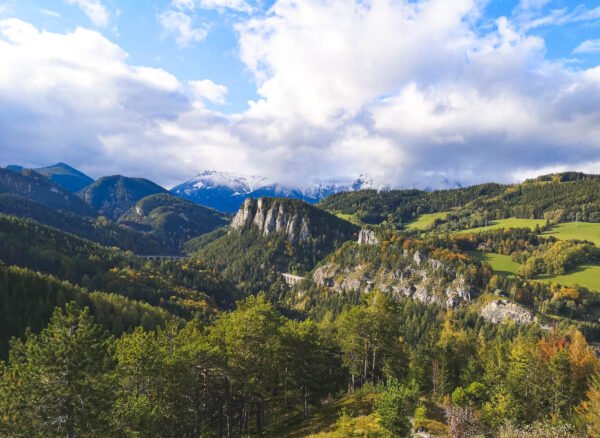
The legendary view from Austrian banknote – “20 Schilling Blick”. Photo by Alis Monte [CC BY-SA 4.0], via Connecting the Dots
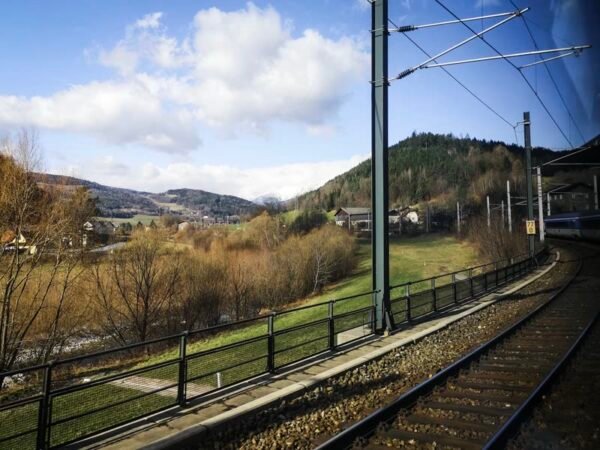
Track, catenary, and the railway landscape. Photo by Alis Monte [CC BY-SA 4.0], via Connecting Vienna
Wartholz Palace & the Habsburgs
Franz Joseph first came for hunting in 1851 and kept a room at the Thalhof. His brother Archduke Carl Ludwig fell harder for the landscape and summers from 1867 onward. The family’s nest was Villa Wartholz — Heinrich von Ferstel’s Italian Renaissance spirit, built through the 1870s into 1884 — more family house than parade palace. Children including Franz Ferdinand grew up between sport, hunting, and tutors from Payerbach. A diary note from the Höllental in 1889 still reads like a teenage Habsburg discovering that gorges are better than court corridors. Otto was born at Wartholz in 1912.
For Kaiser Karl, Wartholz was the true home. He spent the majority of 1907 there, married Zita in 1911, and heard the news of Sarajevo while in the valley in 1914. During World War I the villa became an imperial residence: for about two years the quiet under the Rax functioned as a miniature capital. Exile followed; he died on Madeira in 1922 and was beatified on 3 October 2004. Locally he is remembered at the Barbarakapelle in Küb, among other places — and in the Feldkircher Manifest’s stubborn line about duty that the boards still quote. The Habsburg story here is not a wax museum of crowns; it is a family that used this valley the way Viennese still do: as somewhere the air clears the head.
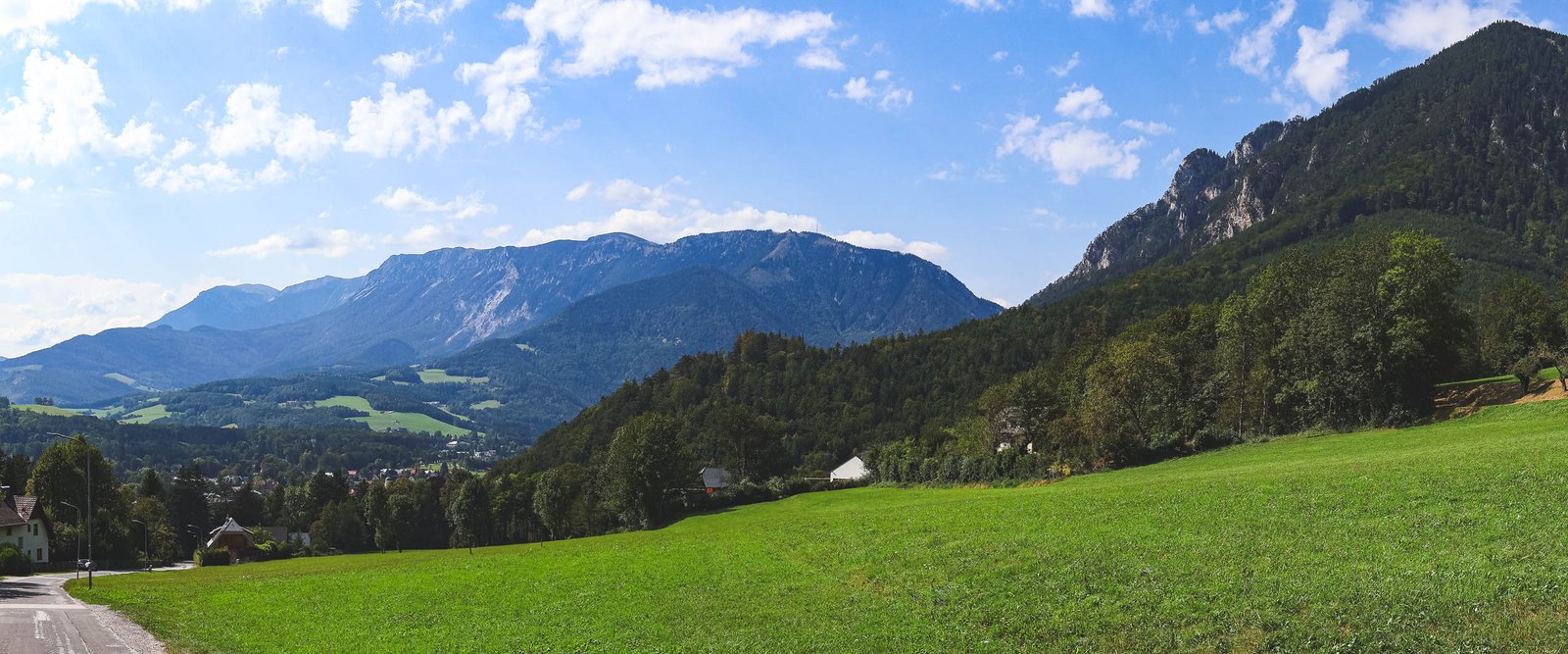
The Rax Alps above Schneedörfl. Photo by Alis Monte [CC BY-SA 4.0], via Connecting Vienna
Küb Post & Telegraph Museum
Rail and mail arrived together. A k.k. post office opened at the station in September 1854 — first in a wooden building, later expanded, with telephone by 1904. A Post-Aufgabe-Amt followed in 1889. Mail ran in dedicated wagons; the southern line had carried mail trains since 1850. Letters, then telegrams, then telephone calls: the same corridor that moved emperors also moved news of births, hunting parties, and “we arrive Saturday, please hold a room.”
Up in Küb, tourism demanded its own counter. From 1902 Alois Lechner ran a postal drop in house no. 7; by 1905 it was a summer post and telegraph office with daily couriers to Payerbach. It survived more than a century and, since 2005, has been a museum — presented on the boards as Austria’s only preserved historic post office of its kind. If you are the sort of traveller who likes small rooms that once ran a whole resort’s correspondence, put it on the list after the platform boards.
Payerbach–Reichenau Sommerfrische
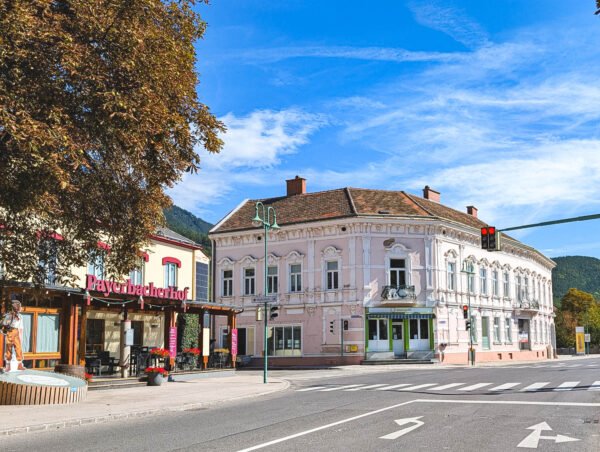
Payerbach. Photo by Alis Monte [CC BY-SA 4.0], via Connecting Vienna
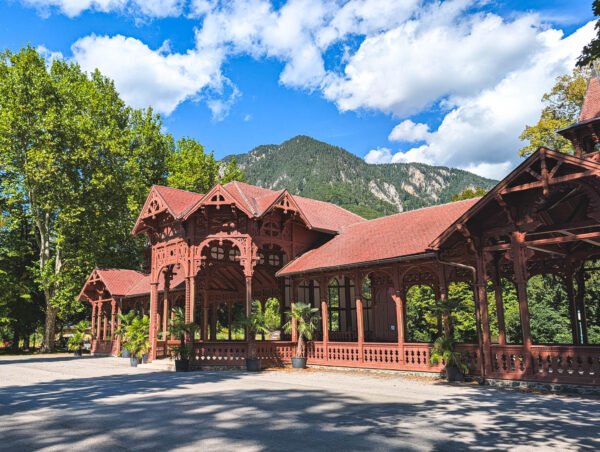
Reichenau. Photo by Alis Monte [CC BY-SA 4.0], via Connecting Vienna
Payerbach’s paper trail starts early: first recorded as “baierbach” in 1094. The hilltop parish church of St. Jacob carries a late Gothic nave and the “Black Tower” finished in 1510. Mining shaped the hills for centuries — bronze-age copper, later siderite, modern galleries from 1791 — and a show mine still offers a subterranean counterpoint to the railway views above. Municipal independence came in 1908; market-town status in 1994. Summer guests appear by 1758. Villa Warrens in Küb hosted, among others, US General Sherman and — in summer 1873 — Empress Elisabeth (Sisi), escaping the Vienna World Fair crowds. The villa did not survive the twentieth century; the anecdote did.
Reichenau began as a Cistercian fief of Neuberg from 1333 for centuries: mining and ironworking first, fashionable air later. An independent municipality opened a new town hall with Franz Joseph present in 1861. The Waissnix family turned the Thalhof into a flagship hotel — peak under Olga Waissnix, famously linked to Arthur Schnitzler. Nathaniel Rothschild’s Loire-style villa (1884) and the imperial orbit around Wartholz sealed the valley’s Nobelkurort reputation. Olga’s August 1888 letter to Schnitzler still stings with honesty: Reichenau is wonderful — and, in high season, unbearable bustle. A perfect summer-resort paradox, recognisable to anyone who has shared a Rax cable-car queue with half of Vienna.
Alpine Spas & Vienna Water
The same mountains that made hiking famous made Vienna drinkable. Kaiserbrunnen in the Höllental — named after Karl VI’s 1728 hunting find — supplied “Gesundwasser” long before the capital’s first high-spring water pipeline. The I. Wiener Hochquellenwasserleitung, engineered under Gabrielli’s era of civic ambition, was ceremonially opened by Franz Joseph on 24 October 1873. Every time you turn a tap in Vienna and think the water tastes oddly alpine, you are tasting this valley’s quietest export.
In the resort itself, the Waissnix brothers opened the late-Biedermeier Rudolfsbad cold-water spa on 17 April 1866 — Hebra and Waissnix in the medical story, Priessnitz-style cures, whey from alpine goats. A heated open-air pool followed around 1910, sold as a sensation with water warmed to about 28°C. The municipal Warmbad’s long story ends, on the boards, with closure from 2021. “Nasses Gold” was never only a spa slogan; it was the valley admitting that water — cold, warm, or piped to the capital — was as valuable as any Habsburg guest list.
Rax Cable Car History
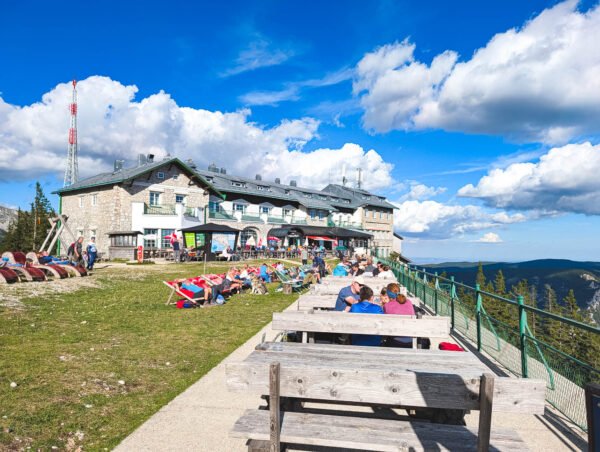
Raxalm-Berggasthof, 1,545 m / 5,069 ft. Photo by Alis Monte [CC BY-SA 4.0], via Connecting Vienna
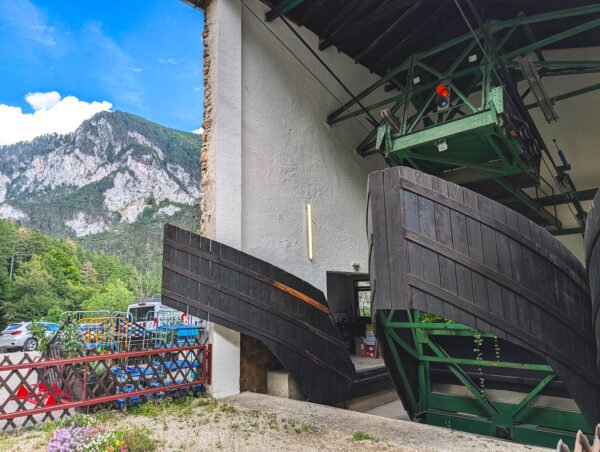
Cable-car machinery at the Rax valley station. Photo by Alis Monte [CC BY-SA 4.0], via Connecting Vienna
Getting onto the plateau took longer than getting to the valley. A railway toward Hirschwang was opposed for decades — money was one reason; summer peace for the powerful was another, with Archduke Carl Ludwig among the opponents. Wartime need for cardboard production finally forced a military line, completed in 1918. After the cable car opened, the Payerbach–Hirschwang valley railway carried passengers from 1926; closed in 1963; revived as a museum railway from 1979. The nostalgic Höllentalbahn you may still catch on selected days is that industrial compromise wearing Sunday clothes.
The Rax cable car itself is the punchline. Rack-railway dreams in the late nineteenth century; a 1913 approval stopped by war; a 1924 concession under Ewald Bing; protests from Alpine clubs and Vienna’s fear for spring-water purity. Built in about a year, opened 9 June 1926 with Federal President Michael Hainisch present — billed as Austria’s oldest passenger cable car, lifting visitors toward roughly 1,546 m. A 1927 newspaper sketch still feels modern: sleek buses racing the elegant local train, fifteen minutes to the valley station, ten more to the plateau, “high-alpine scenery of unusual splendour.” If you are planning trails rather than timelines, our Semmering Railway hiking trails and Zauberberg / Semmering guides pick up where the boards leave off.
Art & Culture in the Rax Valley
Authors who summered here — Nestroy, Schnitzler, Werfel, Doderer — left a literary aftertaste that outlasted the fiakers. Theater Reichenau (building 1926, Seebacher; opened with Die Fledermaus) kept the valley’s evenings alive when the Hofzug no longer cleared platforms. Schloss Reichenau was given for cultural use by Margarete Bader-Waissnix’s foundation in 1992; Lower Austria’s state exhibition Faszination Semmeringbahn arrived in 2003; the permanent Kulturerbe Reichenau strand still frames mining and the “cradle of Sommerfrische.” Culture here is not a tourist add-on bolted onto hiking maps — it is what happens when a railway invents a public and the public refuses to leave when the monarchy does.
Semmeringbahn Timeline
- 1094 — Payerbach first recorded as “baierbach”
- 1333+ — Reichenau as a Cistercian fief of Neuberg
- 1510 — St. Jacob “Black Tower” finished in Payerbach
- 1728 — Kaiserbrunnen spring named after Karl VI’s hunting find
- 1758+ — Early summer guests documented in the valley
- 5 May 1842 — Wien–Gloggnitz railway opens (steam at the Semmering’s foot)
- 1847–48 — Ghega’s design; mountain-section construction begins
- 1851 — Schwarza Viaduct; locomotive competition; Franz Joseph hunts at Thalhof
- 1853 — Kalte Rinne Viaduct (~46 m)
- 17 July 1854 — Passenger traffic over the Semmering; provisional Payerbach stop
- September 1854 — k.k. post office opens at the station
- 1861 — Reichenau town hall opened with Franz Joseph present
- 17 April 1866 — Rudolfsbad cold-water spa opens
- 1867+ — Archduke Carl Ludwig summers in the valley
- 1868 — Stone station (Flattich / Wilhelm)
- 1870s–84 — Villa Wartholz built for Carl Ludwig’s family
- 1873 — I. Wiener Hochquellenwasserleitung opens (24 Oct); Sisi summers at Villa Warrens
- 1884 — Rothschild villa in Reichenau
- January 1895 — Station renamed Payerbach-Reichenau
- 1902 — Court waiting room; Küb Postablage (Alois Lechner)
- 1904–05 — Station telephone; summer post/telegraph office in Küb
- ~1910 — Warmbad (~28°C) opens as a modern sensation
- 1911–14 — Karl marries Zita; Sarajevo news reaches the valley
- 1912 — Otto born at Wartholz; Franz Ferdinand at the station
- 1916–18 — Wartholz as imperial residence; military valley line to Hirschwang (1918)
- 22 October 1918 — Last court train leaves Payerbach
- 9 June 1926 — Rax cable car opens (Hainisch); Theater Reichenau building; valley line carries passengers
- 1963 / 1979 — Valley railway closes; museum railway revived
- 1992 / 2003 — Schloss Reichenau cultural foundation use; state exhibition Faszination Semmeringbahn
- 3 October 2004 — Kaiser Karl beatified
- 2005 — Historic post office in Küb opens as a museum
- 2008 / 1994 — Payerbach municipal (1908) and market-town (1994) milestones still mark local identity
Explore Semmering & the Rax
The boards explain the stack you still use on a day from Vienna: Semmeringbahn → Payerbach-Reichenau → bus or museum railway toward Hirschwang → Rax cable car — and, if you linger, a spa-and-culture valley that taught the capital how to summer. Short history blurbs on our trail and town guides can point here once this hub is live; this page is the deep dive so the practical posts stay practical.
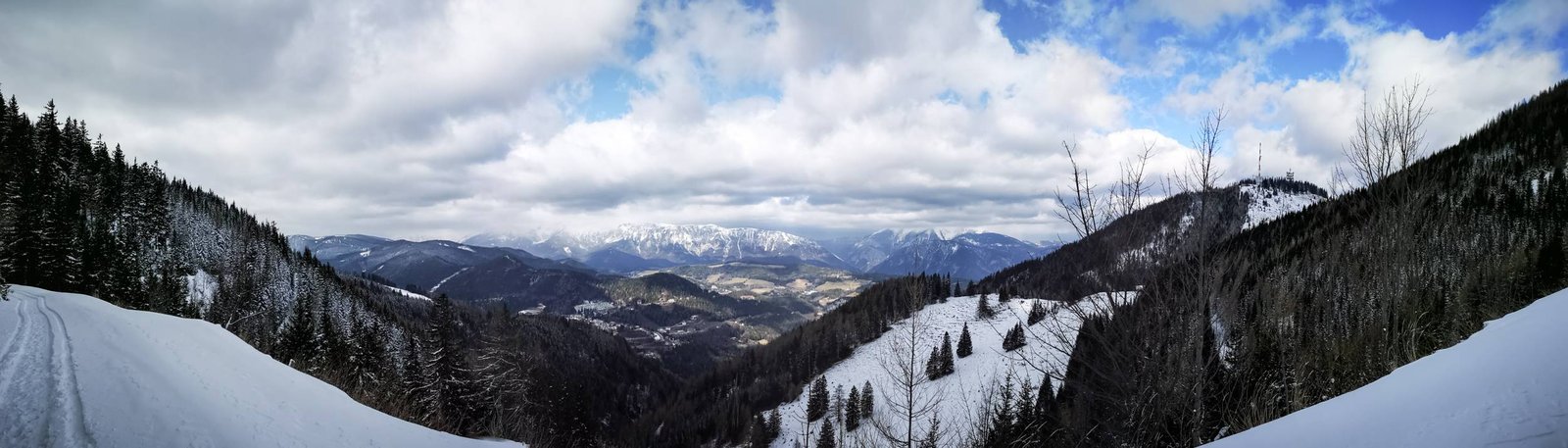
Written by Pallas Athena. Photos by Alis Monte. If you want to collaborate, contact me on hi@connectingvienna.com. Photo by Alis Monte [CC BY-SA 4.0], via Connecting Vienna
Useful links
- Semmering Railway hiking trails — walk the UNESCO line’s viewpoints and valley paths
- Zauberberg / Semmering — neighbouring alpine hub across the pass
- Best hikes in the Vienna Alps — pick the right day-trip mountain for your legs
- Hiking Puchberg am Schneeberg — another classic rail-and-peak combo from Vienna
- Gutenstein & Mariahilfberg — quieter pilgrimage-and-forest alternative nearby
- Payerbach & Reichenau day-trip guide (forthcoming) — practical how-to, buses, cable car, and where to eat once you leave the platform
Stand on the platform again before you go. The twelve boards are not nostalgia for its own sake. They are the reason this valley still feels like Vienna’s alpine front door — engineered by Ghega, crowded by Sommerfrische, remembered by writers, and still the cleanest first step toward the Rax.
Frequently Asked Questions
What is the Semmeringbahn?
The Semmeringbahn is Austria’s historic mountain railway over the Semmering pass, designed by Carl Ritter von Ghega. Passenger traffic opened on 17 July 1854. The roughly 41.8 km mountain section links the Vienna basin with Styria and is a UNESCO World Heritage railway landscape.
Why does Payerbach-Reichenau matter for Semmeringbahn history?
Payerbach-Reichenau was the valley’s busy tourist gateway once the Semmeringbahn made alpine summers reliable from Vienna. The station walls still carry twelve free boards under “Der Historische Bahnhof Payerbach-Reichenau,” covering engineering, Sommerfrische, Habsburgs, mail, spas, and the Rax cable car.
Who was Carl Ritter von Ghega?
Venetian engineer Carl Ritter von Ghega designed the Semmering mountain railway (plan 1847; construction from 1848). He aimed for a maximum gradient of about 25‰ and capped tunnel lengths near 1,500 m so steam could cross a pass many contemporaries called impossible.
When did the Rax cable car open?
Austria’s oldest passenger cable car opened on 9 June 1926 under Federal President Michael Hainisch, after earlier rack-railway plans and a wartime valley line to Hirschwang. It lifts visitors from the valley toward roughly 1,546 m on the Rax plateau.
What is Sommerfrische under the Rax?
Sommerfrische was the Habsburg-era habit of summering in cooler alpine resorts. Under the Rax, Payerbach and Reichenau became a Nobelkurort with hotels, spas, Villa Wartholz, writers such as Schnitzler, and weekend crowds arriving by Semmeringbahn from Vienna.
